Monday, January 31, 2022

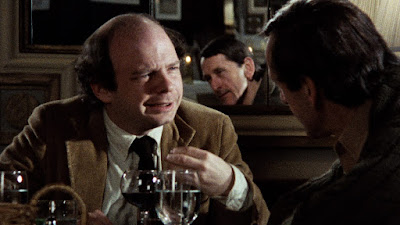
My Dinner With Andre


(“My Dinner With Andre” recently celebrated its 40th anniversary of release, prompting me to watch it once more. The first time I saw the film I was fairly young and both characters seemed to have much more mature “adult” concerns than I could quite connect with at the time. The second time I watched it, I was about Wally's age, and Andre still seemed so old, practically in his twilight years. On this revisit, I'm somehow older than Andre and I gotta say I find these two kids absolutely adorable! Here is a slightly re-edited version of the review I posted for the film's 2009 Criterion release on DVD. Criterion later provided a Blu-ray upgrade in 2015 and that's probably you best bet if you're looking to add “Andrew” to your collection.)

Criterion is releasing three of the most iconic art-house films of all-time this month. Ingmar Bergman's “The Seventh Seal” (1957) helped to establish the art-house exhibition circuit in America and its imagery has been parodied in films like Woody Allen’s “Love and Death” (1975) and, perhaps most famously for American audiences, in Pete Hewitt’s “Bill and Ted’s Bogus Journey” (1991). A hit. You have sunk my battleship.

This month's other releases define two of the extremes of the perceived tendencies of art-house cinema. Alain Resnais' “Last Year at Marienbad” is, for some, the very definition of the impenetrable, hyper-intellectualized puzzle box pitched at self-styled intellectuals who pretend to glean meaning from a flurry of pretentious signifiers. Which is to say, it's just one of those “weird ass” movies that only movie geeks would watch (Ed. Note: It's in my personal Top 10, of course).

“My Dinner with Andre” (1981) represents a different art-house extreme, the quotidian movie in which nothing happens. Two men sit at a table and talk. That’s the whole damn movie, or almost all of it. No Marienbad mysteries here, it's all easy to understand: just soup, a plate of quail, and a lot of jabber. Which is to say it's one of those “boring ass” movies that only movie geeks would watch.

All three movies have carved out a place in popular culture, though “Marienbad” in a more roundabout route through fashion advertisements. For the sheer audacity (or absurdity, depending on your perspective) of its structure and its title, “My Dinner with Andre” has spawned its share of jokes. In “The Simpsons,” nerdy Martin Prince plays an arcade game based on the film, and in “Waiting for Guffman,”Christopher Guest’s character shows off his “My Dinner with Andre” action figures.

The joke in both cases in based on the contrast between “action” and the inertia of the film. But “My Dinner with Andre” is a pretty lively affair with dramatic ebbs and flows like most narrative films. Wally (Wallace Shawn, playing a fictional version of himself) is a playwright who is on his way to visit old friend Andre (Andre Gregory, also playing a fictional version of himself.) On the bus ride to the restaurant, Wally worries about his girlfriend and his career but mostly worries about Andre. He hasn’t seen Andre, also a playwright, in years, and the rumor is that Andre has gone totally crazy.

Once dinner begins, Andre doesn’t do much to dispel the rumors. He speaks of wild adventures in what can only be called “extreme improvisation,” acting workshops in the woods somewhere in Europe that evolve into sub-cultures centered around pagan rituals like ceremonial burials, communing with spirits, and related gibberish.

“My Dinner With Andre” is a downright transgressive film because it brazenly allows its characters to just talk. Actually it allows Andre to talk and, just as importantly, for Wally to listen. For the first hour or so, Wally does almost nothing but say “So what else happened?” as Andre rambles from one silly anecdote to another. Few actors would be willing to just sit there and do nothing but listen, but then again Shawn and Gregory did conceive and write the play, only bringing Louis Malle in to direct at a later stage of the project.

Watching the movie again, I realized that Wally is a genuine hero. As Andre blathers about one spiritual, transcendent experience after another, he becomes increasingly annoying, his mind so “open” to possibilities that he has abandoned all skeptical rigor. Finally Wally, fortified by the first few dinner courses (fish pate and roasted quail), can’t take it anymore: “Do you want to know my actual response?” Yes, Wally, we do! Slay that New Age dragon with your sword of reason!

Wally defends his bourgeois existence with gusto. Andre, to his credit, is a good sport about it. Deep down, he knows he’s peddling snake oil and it becomes clear that he really does value Wally’s friendship. It would have been too easy for the final act to end acrimoniously, providing a traditionally dramatic denouement. But they do what respectful friends do. They talk out their differences and get to know each other a little better in the process.

One of the pleasures of “My Dinner With Andre” is the opportunity to see things not normally considered important enough to depict on screen. As mundane as it seems, we rarely get to watch other people have a simple dinner conversation. Of course, this is a rehearsed, highly polished conversation between two performers riffing on their real life personas, but still the film’s explicit argument is that a mundane event like this is worthy of being put on film (directed by a genuine celebrated auteur, no less!) and subsequently being viewed by others. And the fact that it remains a popular draw even today is proof that the film’s argument is a valid one.
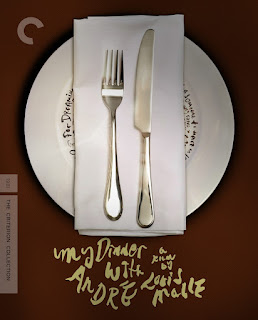


Video:

The film is presented in a 1.66:1 aspect ratio. “Andre” was filmed in 16mm and blown up to 35mm, so the image is grainy and the resolution is not as sharp as we’ve become accustomed to from Criterion but that’s because of the source material, not the transfer. It’s a very solid effort.

Audio:

The DVD is presented in Dolby Digital Mono. Dialogue is clearly mixed. Optional English subtitles support the English audio.

Extras:

Both extras are on Disc Two of this 2-disc set.

Director Noah Baumbach records separate interviews with Andre Gregory and Wallace Shaw, each about a half hour long. They’re included in the same feature and can be watched either separately or an hour long program. They were recorded recently for the Criterion Collection.

“My Dinner with Louis” (42 min.) is a 1982 episode of the BBC program “Arena.” Wallace Shawn meets with Louis Malle in Atlantic City to discuss Malle’s career. Directed by Tristram Powell.

The insert booklet includes an essay by Amy Taubin and the prefaces written by Wallace Shawn and Andre Gregory to their published screenplay.

Final Thoughts:

Watching “My Dinner with Andre” on DVD gives viewers the chance to pay attention to the lesser-discussed aspects of the movie.While Louis Malle shoots in a fairly straightforward matter, shifting between close-ups and two-shots, the strategic placement of a mirror behind the dinner companions gives the longer shots more energy and keeps Andre’s face in view even when he’s turned away from the camera. And then of course there’s the marvelous waiter, played by non-professional actor Jean Lenauer, who likes like he might have snuck in from a French B-horror movie.

If you’ve only heard of “My Dinner with Andre” by way of its pop culture parodies, you may have some preconceptions about the film. Place them aside and watch the movie with a fresh eye because it’s a lot more vibrant and flat-out entertaining than you might think. It’s not just a “boring ass” movie for movie geeks. It’s lots of fun.

Wednesday, January 12, 2022

My Favorite Films of 2021


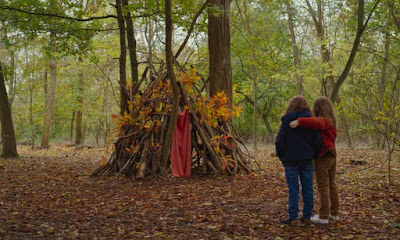
Petite Maman

The focus of this blog has always been on coverage of DVD and Blu-ray titles. It's right there in the name of the site. A few years ago my supply of screeners, once a raging torrent that flooded my mailbox each month, slowed to a trickle, and now appears to have shut off completely, a rough match for the trajectory of DVD sales over the past decade. I believe physical media is as important as ever – who wants to be dependent on the vicissitudes of the array of mercurial streaming channels we've all cobbled together to form our personal archives – but I can't escape the fact that it's mighty difficult to review releases that I don't have.

Do I now have to resort to reviewing new theatrical releases? What a depressing thought. Not that there aren't worthwhile films produced every year, but I've always been mildly embarrassed that the bulk of film criticism ignores 125 years of film history to focus on whatever happens to be in a theater (or its streaming proxy) this month. Just imagine only reading new books. Bo-ring!

Anyway, speaking of those worthwhile films released every year, it's time to talk about my favorite movies of 2021. As always, I'm sure I've missed seeing plenty of quality contenders: Tsai Ming-Liang's “Days,” Ryusuke Hamaguchi's “Wheel of Fortune and Fantasy,” Joanna Hogg's “The Souvenir, Part II” and more.

My Top 10 of 2021:

Petite Maman (Sciamma)

Pig (Sarnoski)

Spider-Man: No Way Home (Watts)

Summer of Soul (Questlove)

Memoria (Apichatpong)

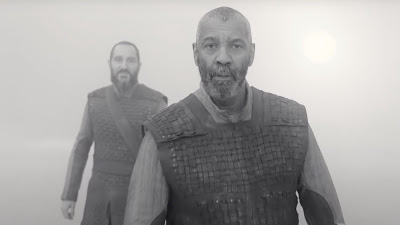
The Tragedy of Macbeth (J Coen)

Bad Luck Banging or Looney Porn (Jude)

The Card Counter (Schrader)

Passing (Hall)

Flee (Rasmussen)

And Six More That I Liked A Lot:

The Worst Person in the World (Trier)

Annette(Carax)

About Endlessness (Andersson)

Shang-Chi And The Legend Of The Ten Rings (Cretton)

Nightmare Alley (Del Toro)

Bergman Island (Hansen-Love)

If you don't count the end credits, Celine Sciamma's “Petite Maman” clocks in under 70 minutes, but that's not the only reason this little gem is one of the year's best movies. Eight-year-old Nelly (Josephine Sanz) has just had to say goodbye to her beloved maternal grandmother. While grieving, Nelly helps to clean out the old family home and meets a very special new friend. The film spends almost all of its compact running time following young Nelly closely, relishing in the opportunity to show little girls at play, and providing a fresh, intimate perspective on the mother-daughter relationship. The film subtly and methodically builds up to an ending that's both surprising and deeply affecting. I'm still thinking about it a month later.

“Pig” has been creatively marketed as “John Wick, but with Nicolas Cage and a pig” which sounds freaking awesome and also promises some bonkers thrills. Cage plays Rob, a bearded recluse holed up in a shack in the woods with only his truffle-hunting pig for companionship. When his best friend is pignapped, Cage reluctantly treks back to the seedy urban jungle (Portland, OR to be precise) for either rescue or revenge. As you watch Cage get beaten half to death in one of those infamous underground fight clubs run exclusively by off-duty restaurant workers, you're expecting the gonzo fury to fully erupt, but screenwriter/director Michael Sarnoski provides the biggest shock by steering the film in a much more serene, contemplative direction. “Pig” winds up being a surprisingly moving portrait of grief and an impassioned testament to the value of artistic integrity in an increasingly homogenized commercial world. Cook what you want to cook – your very soul may depend on it.

“Spider-Man: No Way Home” is packed to the gills with shameless fan service and constructed by an established crowd-pleasing formula, but just as the Egg McMuffin is designed in the lab to be the tastiest damn sandwich in the world, this new MCU entry sure goes down smooth. I think what I love best about this goofy plot is that all of its multiverse-spanning mayhem stems entirely from the fact that Peter Parker just can't shut the hell up for a minute. Talk about respect for the source material! From the instant I first saw Tom Holland in “Captain America: Civil War” (2016), I thought he fully embodied the Peter Parker of the comic book pages, and he still owns the role, even while sharing the screen with his worthy predecessors. This movie is pure Marvel joy from start to finish. After a bit of a lull, the MCU finished the year very strong with both “No Way Home” and the immensely entertaining “Hawkeye” series.

Speaking of pure joy from start to finish, “Summer of Soul,” Questlove's jawn/documentary about the 1969 Harlem Cultural Festival, is an absolute blast. Held over six weeks in the summer, the “Black Woodstock” featured an all-universe lineup, ranging from newcomers like a teenager named Stevie Wonder to veteran stars like Mahalia Jackson, with Gladys Knight and the Pips, The 5th Dimension, Sly and the Family Stone, and Nina Simone sprinkled in just to keep everyone entertained. I admit that I knew nothing about this concert and I suspect the same will be true for many viewers, which is one of the primary reasons Questlove decided to edit together this long-unseen footage into the most electrifying music documentary to come along in years.

In Apichatpong Weerasethakul's “Memoria,” Jessica (Tilda Swinton) hunts down a sound that has been haunting her (waking?) dreams. It's a bounce, a thump, kind of earthy. Are we even hearing the same noise Jessica does? When an audio technician who helps her pinpoint the elusive sound suddenly disappears, “Memoria” begins to feel like a detective story or perhaps psychological horror, and it might be both of those things, but to pigeonhole it as anything other than “the new film by Apichatpong Weerasethakul” seems inadequate. As with the Thai master's earlier films, perhaps it's best to just immerse yourself in the sensory experience, turn off your cognitive filters, and just dream along with it.

The Scottish Film

“The Tragedy of Macbeth” is easily the most visually seductive film I saw this year, and cinematographer Bruno Delbonnel deserves to win every award for his black-and-white photography that somehow looks both sleek and archaic at the same time. Denzel Washington and Frances McDormand deserve all the praise they've received for this primal scream of a staging, but I have to give a shout out to Kathryn Hunter for bringing an intense physicality to the Weird Sisters that I've never seen in any other adaptation of the Scottish Play.

Romanian director Radu Jude's “Bad Luck Banging or Loony Porn” may be the first great feature film set in the pandemic year(s). Emi (Katia Pascariu) wanders through a Bucharest populated by people wearing masks, face shields, animal costumes, and billowing cloaks of incoherent rage. But lest you think the film suggests a year-plus of lockdown has made everyone crazy, it ticks off a methodical checklist of historical lunacy proving that the crazy has always been there, just bubbling to the surface now in a different form. For a film that starts with a four-minute hardcore sex tape, “Bad Luck” covers a dizzying range of subjects with a radical flair that makes it feel like a forgotten film of the late '60s. It must have been part of some kind of New Wave, right? Its final act also demonstrates how exhausting it must be to be a rational, educated person calmly making an informed argument in an environment where the most meticulously researched facts can be dismissed by someone blowing you a raspberry and calling you a bitch. I also appreciate that Jude chose a title guaranteeing that the film will only be seen by film critics and other perverts.

I still don't understand what card counting has to do with playing poker, but that's no hindrance to appreciating Paul Schrader's latest take on God's Lonely Man by way of Robert Bresson. In “The Card Counter,” Oscar Isaac (delivering one of the best lead performances of the year) plays a man recently released from military prison, though not released from his blighted past. While atoning for his sins (to be identified later), he scrapes together a peripatetic living as a low-stakes gambler, content to bet small and stay off everyone's radar – maybe even God's? Backed by an investor (Tiffany Haddish, in a sparkling supporting turn), he's willing to play for higher stakes in order to save the soul of a very angry young man (Tye Sheridan) he meets on the road. Anyone familiar with Schrader's work can call out the Bresson influences along the way (we start with “A Man Escaped,” yep that's “Diary of a Country Priest” right there, and you better believe we're gonna end with “Pickpocket”) but Schrader has long since synthesized the Bressonian sensibility into his own purified vision. As a follow up to the indelible “First Reformed” (2017), this film is clear evidence that Schrader is doing the very best work of his career right now.

Rebecca Hall's adaptation of Nella Larsen's novel “Passing” is so assured and focused it's hard to believe it's her directorial debut. Hall also adapted the screenplay which doesn't waste a scene, hurtling forward through a series of itnense moments in the developing friendship/rivalry between Claire (Ruth Negga), a light-skinned black woman passing as white in prohibition-era New York, and her old high-school friend Irene (Tessa Thompson). The slight resentments and affections each feels toward the other propel the narrative to its powerful and seemingly inevitable conclusion, all bolstered by luminous black-and-white cinematography by Eduard Grau. Thompson and Negga are both sensational.

“Flee” is simultaneously one of the best animated films of the year as well and one of the best documentaries. Danish filmmaker Jonas Poher Rasmussen tells the story of his friend Amin (name and animated likeness changed to protect his identity), an Afghan refugee who immigrated to Copenhagen as a teenager. Amin's harrowing refugee tale is paired with his story of coming-of-age in Kabul while realizing he is homosexual, a journey that quite charmingly involves an obsession with the films of Jean-Claude Van Damme, The Muscles from Brussels. Amin's voice is the star and organizing principle of this riveting story.

Thursday, September 30, 2021

Love & Basketball


LOVE & BASKETBALL (Prince-Bythewood, 2000)

Criterion Collection, Blu-ray, Release Date Sep 21, 2021

Review by Christopher S. Long

Battle-tested by the age of 11, Monica Wright (Kyla Pratt) already understands that she's going to have to prove herself over and over again. After her family moves into an affluent black neighborhood in Los Angeles in 1981, she must earn her right to play on the basketball court with the boys. One cocky youngster barely has time to scoff that “Girls can't play no ball” before she's driving to the hoop. Her game impresses young Quincy McCall (Glenndon Chatman), no mean feat since Quincy has high standards: his dad Zeke (Dennis Haysbert) plays in the NBA. For the Clippers, mind you, but that still technically counts as the NBA.

Quincy decides Monica should be his girl, an “honor” she grudgingly accepts with a kiss, then promptly rejects once she realizes Quincy now expects to be the boss of her. Monica has no intention of taking orders, or guff, or crap of any kind from anyone, something Quincy discovers once she jumps him and wrestles him on the lawn. It's tough to like Quincy's chances in this match.

This childhood interlude is the muddy, grass-stained launching pad for a lifelong romance, one told with conviction and panache by writer-director Gina Prince-Bythewood in “Love & Basketball” (2000). The film, divided by title cards into four quarters, leaps ahead to the second quarter, circa 1988, when both Monica (now played by Sanaa Latham) and Quincy (Omar Epps) are high-school basketball stars. Quincy is the golden child, a pedigreed star guaranteed his choice of any college program. Monica, as always, has to fight much harder for everything she wants, playing her heart out for the tenuous hope of being recruited.

Dating is a nuisance she hardly has time for- gotta work on her outside game - but the spring dance is coming up, and she feels pressured to go, partly by her devoted mother (Alfre Woodard), who wants to see her tomboy daughter dressed to the nines, and partly because Quincy will be there. They're just friends who happen to live next door and share a love of basketball – honestly, they're just friends, but still, she wants to check in with him on the school's big night.

“Love & Basketball” has become a fan favorite since its release just over 20 years ago, and I suspect admirers fall in love with it at the same point Monica and Quincy officially declare their love. Prince-Bythewood's script deftly balances authenticity with the occasional fairy tale flourish that puts the romance over the top. Perhaps her savviest decision is to have Monica's and Quincy's bedrooms facing each other. Any time Quincy needs to escape from hearing his parents argue, he can just climb out onto the thin hill of grass that separates their rooms, knock on Monica's window, and have a safe refuge for the night. After they've both returned home on the night of the dance, their respective dates long since dispatched, they meet on the lawn and fall into each other's arms, a lifetime of yearning finally boiling over.

It's a beautiful moment, but college, with its whole new set of challenges, awaits in the third quarter. They both play at UCLA where they are now officially girlfriend and boyfriend. Repeating a pattern, the much-ballyhooed Quincy weighs leaving school early for the promise of being a lottery pick, while Monica scraps just for a chance to get on the court and showcase her mad skills. On first consideration, I felt the film took a wrong turn here, as the sweet, loving Quincy abruptly turns mean and selfish, but now I think Prince-Bythewood, herself a gifted high-school basketball player, understands well the difference in entitlement between male and female college athletes. Praised his whole life, Quincy expects the support of everyone on his predetermined path to fame and fortune. So when Monica makes even one modest decision to pursue her career (observing team curfew) instead of consoling Quincy when he feels down, he turns on her, placing their entire future in jeopardy. He's not accustomed to adversity and responds petulantly to even the slightest setback.

Monica truly loves Quincy, but she won't abandon her career plans for him, the way she feels her mother did to support her father, a successful banker. “Love & Basketball” would be a far lesser film if Monica ever lost focus on her own goals, and her commitment only makes their relationship, as well as Monica's ultimate on-court fate, feel all the more fully-earned.

“All's fair in love and basketball,” says Quincy. And all feels true in Prince-Bythewood's “Love & Basketball”, even its happily-ever-after ending.


Video:

The film is presented in its original 1.85:1 aspect ratio. From Criterion: “This new digital transfer, supervised by director Gina Prince-Bythewood, was created in 16-bit 4K resolution from the 35 mm original camera negative...” This 1080p transfer is pristine, another top notch Criterion release.

Audio:

The DTS-HD Master 5.1 audio track is sharp and robust with strong depth throughout. The score by Terence Blanchard as well as the film's pop songs also sound great with this mix. Optional English SDH subtitles support the English audio.

Extras:

The film is accompanied by two older commentary tracks. The two options are a track by Prince-Bythewood and Sanaa Lathan, recorded in 2000, and another track by Prince-Bythewood, editor Terilyn A. Shropshire, and composer Terence Blanchard, also recorded in 2000.

The “Making Of...” feature (2021, 38 min.) involves several cast and crew members, including Prince-Bythewood, Omar Epps, Sanaa Lathan, and Alfre Woodard. Prince-Bythewood speaks about her own experience as a high-school basketball player as well as her early career as a writer on “A Different World” and other shows.

In another interview (2021, 16 min.), editor Terilyn A. Shropshire discusses her work on the film, and how she came to join the project via a recommendation from Spike Lee (who is also a co-producer on the film).

Criterion has also included a short feature (2021, 22 min.) which consists of a Zoom meeting between Prince-Bythewood, WNBA Hall of Famer Sheryl Swoopes, and writer-actress-producer Lena Waithe. The three women discuss how they've pursued success in their various careers, as Monica does in “Love & Basketball.”

The disc also includes Deleted Scenes (8 min.) and Audition tapes (9 min.), of both the adult actors and child actors who portrayed Monica and Quincy.

Criterion continues to stack the disk with two of Prince-Bythewood's short films. “Stitches” (1991, 31 min.) was her thesis film at UCLA Film School and tells the story of a troubled female stand-up comedienne. “Progress” (1997, 3 min.) is a very short film that juxtaposes Klan violence in the 1960s with gang violence in the 1990s.

The final extra on the disc is a Trailer (2 min.)

Final Thoughts:

Prince-Bythewood recently scored a Netflix hit with “The Old Guard” (2020), but her debut feature “Love & Basketball” has been winning hearts for over 20 years. Criterion has given the film a proper treatment with a great high-def transfer and a strong collection of extras.


Wednesday, September 29, 2021

Throw Down


THROW DOWN (To, 2004)

Criterion Collection, Blu-ray, Release Date Sep 21, 2021

Review by Christopher S. Long

At first blush, Johnnie To's “Throw Down” (2004) appears to be the rare martial-arts movie in which nothing much is at stake. Cocky young Tony (Aaron Kwok) challenges the best judo fighters in Hong Kong not to seek revenge for a past slight or to restore honor to his family name. Nobody will live or die based on the outcome of these bouts; heck, there isn't even a cheap tin trophy cup on the line. Tony just wants to fight because it's fun, and the big goofy grin on his face when he has the chance to spar against a worthy opponent speaks of the sheer kinetic thrill of the moment, the rare opportunity to test your skills and feel alive, the chance to really just, well, throw down.

Tony particularly craves a match with Szeto Bo (Louis Koo), a celebrated former judo champion turned karaoke bar manager. Szeto, however, is mostly in grappling with his next glass of whiskey or pulling of his next scam, as he sinks deeper into depression every day. Tony tries to bolster Szeto's spirits (he needs him in peak fighting shape, after all) and is joined in the endeavor by the high-spirited Mona (Cherry Ying), an aspiring singer/actress eager for a life free of a manager who'd rather be her pimp. Szeto resists with a masochistic stubbornness familiar to anyone who has wallowed in their own misery for years, but Tony, Mona, and several supporting characters refuse to give up. Soon it becomes apparent that the stakes in “Thrown Down” are actually quite high - nothing less than the redemption of a lost soul.

To hurtles into each scene as if it's the only moment that ever existed, sometimes with disorienting results. Shortly after they all meet, Szeto leads Tony and Mona to an arcade where, for some reason, he insists that Tony play a Mortal Kombat-style game, something the young man does with his usual ferocity, attracting attention from the other gamers. The whole sequence then abruptly shifts into a heist, one that hasn't so much as been hinted at before, but Szeto knows his plan and the audience can just catch on at their own pace. Character introductions are handled with efficiency as well. We meet Mona as she blissfully slurps a bowl of noodles while being harangued by the furious landlady who has just evicted her, instantly establishing both her predicament and her personality with no wasted set-up.

The film also provides no obvious clues as to why Szeto is so depressed, until a sudden late revelation, and by then it hardly matters. OK, it matters quite a bit, but of far greater significance is the devotion of so many of Szeto's friends (some old, some new, all equally supportive) to his rehabilitation. Even the mobster Szeto rips off at the arcade wants to help and, oh by the way, he wants to fight too. Almost everybody in the movie is crazy about judo, a bit of a joke by the filmmakers since judo isn't particularly popular in Hong Kong.

While “Thrown Down” features several rousing judo fights, both one-on-one matches and chaotic mass street rumbles, its central appeal rests on its emphasis on the healing power of friendship. A charming sequence in which the three main characters join forces to rescue a red balloon trapped in a tree, only to immediately release it to the heavens, captures the true essence of this sweet and idiosyncratic film, a genre mashup both melancholic and life-affirming.

A relative lack of exposition (relative to Hollywood narrative, at least) may make “Throw Down” occasionally frustrating for viewers who always want to know why characters are doing what they're doing. But once you realize you can trust the filmmakers to be sincere, true both to the characters and to the audience, you can just relax and live in the moment, like the film does.


Video:

The film is presented in its original 2.35:1 aspect ratio from a “new 4K digital transfer.” The 1080p transfer is sharp with deep, rich colors. No noticeable issues with another top-flight Criterion transfer.

Audio:

The DTS-HD Master 5.1 surround track is clean and efficient, and sounds great even in some of the messy crowd/fight scenes. Optional English subtitles support the Cantonese dialogue.

Extras:

Criterion has includes several features for this release, some older and some made just for this release.

The collection starts with a 2004 interview (40 min.) with Johnnie To, in which he discusses the genesis and development of “Throw Down.” The disc also includes a 2004 “Making Of” featurette (11 min.) which is mostly a promotional film that doesn't offer too much insight.

The new features consist of four interviews conducted by Criterion. First up is screenwriter Yau Nai-Hoi who talks about how the script was originally a light comedy which To wanted to develop into something more nuanced. He also speaks about To's propensity to improvise on set. Composer Peter Kam (11 min.) credits To with a natural musical rhythm in his pacing of scenes, while echoing Yau's comments about To's preference for making changes on set.

Criterion has also invited two film scholars to contribute. David Bordwell (21 min.) speaks about some of the differences in the film's narrative and editing vs. more standard Hollywood approaches. Caroline Guo (12 min.) discusses how atypical “Throw Down” both in terms of genre conventions and compared to most of To's other work.

The extras wrap up with a Trailer (2 ½ minutes).

The fold-out insert booklet features an essay by film critic Sean Gilman, who discusses both the film and To's prolific output in the late '90s and early 2000s.

Final Thoughts:

Johnnie To also styles “Thrown Down” as an overt homage to Akira Kurosawawa, particularly his early judo film “Sanshiro Sugata” (1943). This only adds to the film's upbeat message. “Throw Down” is ultimately a great hang-out movie, with unlikely friends finding pleasure in each other's company, just chilling and helping each other out. Who wouldn't want to throw down with that?


Monday, September 13, 2021

A Touch Of Sin

Dahai (Jiang Wu) gets even
A TOUCH OF SIN (Jia, 2013)
Kino Lorber, Blu-ray, Release Date April 8, 2014
Review by Christopher S. Long

It's both exciting and confusing when a filmmaker appears to make a decisive break with his previous work, complicating the picture for critics who thought they had him conveniently pigeonholed. Jim Jarmusch caused plenty of consternation with the release of his revisionist Western “Dead Man” (1996). While he certainly laced his entry in the quintessential American genre with his trademark deadpan humor, the easy-going satirist had made a surprisingly violent film, a scabrous indictment of the genocide inflicted by “stupid fucking white men” on Native Americans. Blood spurted, skulls were crushed, and bodies piled up in this nightmare on earth. Fans looking for the gentle laughs of “Down By Law” didn't quite know what to do, and a few former critical boosters (like Roger Ebert) took the opportunity to jump ship.

“A Touch of Sin” (2013) is, at least in some ways, director Jia Zhangke's “Dead Man.” There are noteworthy parallels between Jia and Jarmusch, though they shouldn't be overstated. Both directors cite Robert Bresson as a formative influence and both have often been attracted to marginalized protagonists surviving on the fringes of urban society. Like Jarmusch (born in 1953), Jia (born in 1970) is viewed as one of the defining figures of his generation's independent film movement; bootleg copies of Jia's heavily censored early films like “Pickpocket” (1997) changed hands regularly on the Chinese black market and inspired legions of cineastes from Jia's home province of Shanxi all the way to Beijing (and even attracted financial support from Takeshi Kitano's production company in Tokyo).

From the festival breakthrough “Platform” (2000) through critically praised works such as “The World” (2004) and “Still Life” (2006), Jia established himself as one of the preeminent chroniclers of China's rapid transformation to an industrial and capitalist economy, a globe-altering metamorphosis that displaced millions of Chinese citizens. Jia's characters face off against forces too big even to acknowledge their existence, but while his movies are inevitably tinged with a sense of sorrowful resignation, they also became increasingly playful, occasionally outright hilarious. They have also been, to the exasperation of many “slow cinema” skeptics, long on patient observation and short on dramatic incident.

“A Touch of Sin,” by contrast, plunges headlong into incident: no fatalistic watching and waiting here. In the first few minutes, a man on a motorcycle is accosted by thugs armed with hammers and axes; his handgun wins the day and initiates a body count that reaches double digits. And he's not even the main character of the opening section of a film organized into four separate but loosely connected segments (another Jarmuschian parallel, though JJ doesn't exactly own the format). 

Dahai is still mad
 That honor belongs to Dahai (Jiang Wu), a former coal miner turned social crusader in Shanxi who rages against the corruption of local officials who sold the publicly-held mine and clung very privately to the profits. Brash and loud-mouthed, he has probably never been good at winning friends and influencing people, but he does his best to funnel his furious protests through official channels before personally confronting the big boss, a meeting that winds up with Dahai being savagely beaten with a shovel wielded by one of the boss's thugs. Whether spurred by his head trauma or his innate obstinacy, Dahai grabs a shotgun and cuts a bloody swath through town starting with a low-level crooked accountant and ending with the money-grubbing politicos at the top.

Like most of the violence in the film, the shootings are artfully and artificially staged. Heads explode, bodies launch through the air on wires, geysers of blood soak clothing and walls. Nothing coy here, but also nothing particularly realistic. These are movie murders and Jia makes overt references to films most Western viewers (including yours truly) aren't too familiar with; the movie's English title is a pun on King Hu's popular wuxia (martial arts) film “A Touch of Zen” (1971). 

Xiaoyu (Zhao Tao) makes her point
 Jia loves to collapse the barriers between documentary and fiction, and freely mixes surrealism with naturalism. That's not quite what he's up to here, but it might explain the movie's abrupt detours into full-blown “movie-dom.” In the third segment, Xiaoyu (Zhao Tao, Jia's long-time muse and now wife) works in the “Nightcomer Sauna” as a receptionist. A pushy businessman mistakes her for something else and won't take no for an answer as he insists on a “massage.” The otherwise passive Xiaoyu reaches in her purse for a switchblade and, posing like an avenging angel from one of a host of wuxia films, slices the abusive john to bits, then wanders the streets in a daze, drenched head to toe in blood. I've spoken to some viewers who find moments like this distracting or phony, but they're intended to disrupt the apparent realism of each situation, though with my lack of familiarity with the cultural touchstones Jia references, I'm reluctant to guess precisely what his motivations are.

All four of the movie's major stories are drawn loosely from real-life incidents in China that went largely ignored by the state-controlled media. I don't know enough to claim that violent crime has become more common in China over the past decade or two, but “A Touch of Sin” definitely portrays a nation traumatized by upheaval, with money being the root of all brutality. In the final segment, a feckless but generally well-meaning teenager (Luo Lanshan) loses his soul to the twin destructive forces of young love and factory work, Jia's response to a rash of suicides by assembly-line employees at the multinational corporations that rushed in to exploit cheap Chinese labor. The protagonist of the second segment (Wang Baoqiang, also the motorcyclist from the opening) may be the most damaged character of all, but his dysfunction is more difficult to link to current events: he is a killer who likes to shoot guns because everything else (including village life with his family) is too boring. Perhaps the fresh whiff of prosperity, tantalizingly out of reach by legal means, has made it difficult for him to play by the rules anymore.

I should note that I haven't seen Jia's first film “Pickpocket” so it's possible that what I'm describing as a major departure is a return to roots. However, “A Touch of Sin” is not only much more graphic than Jia's previous 21st century movies, it also moves at a more relentless pace with few of the long, contemplative takes that have marked most of his work. The movie races from one violent eruption to the next, and the sense of inevitable tragedy builds implacably. There are still a few moments of Jia-esque humor (Dahai, in the midst of his righteous rampage, prepares to kick down a door but stumbles when startled by a phone ringing off-screen) but everyone here is just circling the black hole at the center of capitalist China, waiting to spiral into its gravity well and be torn to shreds.

It's all quite a shock for a Jia fan expecting more “Still Life” and it's a challenge to process. It might be my least favorite of his movies, but I still count it as one of the best films of 2013 which should tell you what I think of this extraordinary filmmaker. I can't wait to see whether this marks a new turn in Jia's career, or if it will turn to be a bracing exception. 


Video:
The film is presented in a 2.35:1 aspect ratio. This high-def transfer from Kino Lorber has the slightly soft look of a movie originally shot on HD with the occasional instance of digital blurring in scenes with rapid motion, but nothing significant that would detract from the viewing experience. Image detail is sharp throughout and colors are vibrant, though the film (shot by Jia's long-time collaborator Yu Lik-wai) is not exactly meant to look beautiful. The look ranges from drab (a lonely, ignored statue of Mao overlooks a declining town square in Shanxi) to gaudy (a nightclub/sex fantasy room made up to look like a train car reserved for party officials) and the 1080p image presents it all vividly, though with a few flaws.

Audio:
The DTS-HD Master Audio 5.1 soundtrack is crisp and has a convincing sense of depth; gunplay almost overwhelms the speakers at times. The sound is as angry as the story at times. Optional English subtitles support the Mandarin and Cantonese dialogue.

Extras:
All we get are five trailer for films from Kino Lorber.

Final Thoughts:
In my review of “Still Life,” I described Jia Zhangke as my favorite under-50 director. I've had no reason to revise that claim. “A Touch of Sin” may be his most accessible movie, admittedly an ambiguous description. It won Best Screenplay for Jia at Cannes in 2013 and placed highly on most year-end critical polls. Unfortunately this is a bare-bones release from Kino Lorber, but it's great to have this available to more viewers. Everyone needs “A Touch of Sin.”

Thursday, September 2, 2021

Still Life


STILL LIFE (Jia, 2006)

Playing on the Criterion Channel in September 2021

Review by Christopher S. Long


This month, the Criterion Channel is featuring eight films by Chinese director Jia Zhangke: “Xiao Wu” (1997), “Platform” (2000), “Unknown Pleasures” (2002), “The World” (2004), “Still Life” (2006), “24 City” (2008), “A Touch of Sin” (2013), “Mountains May Depart” (2015).

Jia may be my favorite filmmaker of the 21st century, so I'm posting a few reviews intended to encourage viewers to check out these extraordinary films while they're available on such a great platform.


Writer-director Jia Zhangke is perhaps the most prominent member of the Sixth Generation of Chinese filmmakers; he also happens to be one of the very best filmmakers working today. His first breakthrough hit on the festival circuit was “Platform” (2000) and he sealed his reputation as a modern master with 2004’s “The World”, the best movie ever made about cell phones.

Jia’s career continued to soar, and in 2006 he exploded onto everyone’s radar by winning the Golden Lion in Venice with “Still Life.” “Platform” was set in Jia’s hometown province of Shanxi in central China. In “Still Life” he sends two Shanxi natives south to Fengjie along the Yangtze River. Like many areas along the river, most of the residents of Fengjie have been displaced by the massive Three Gorges Dam project, now the largest power station in the world.

Coal miner Han Sanming (Han Sanming, a real-life coal miner who had small roles in earlier Jia films) has come to Fengjie to find his ex-wife and daughter, neither of whom he has seen in sixteen years. Treated in a largely separate story, nurse Shen Hong (Zhao Tao, Jia's frequent collaborator and now his wife) comes searching for her estranged husband. Both of these seekers will have to be very patient, as will viewers.

The only growth business left in the 2000-year-old town is demolition. Unable to locate his wife at her now submerged address (“See that island? That’s your town.”), Han settles for work on a crew while he waits for his wife to return. There’s really not much left to do in Fengjie except to wait. Shen Hong has to wait too, as her husband is a big-time boss (of the demolition company) who is difficult to track down. She whiles the time with one of her husband’s friends and glides along the fringes of the local business community.

As is usually the case with Jia, plot recedes into the background as time and location are emphasized. Working with high-def video, Jia and his great cinematographer Yu Lik-wai explore the environment so thoroughly and with such attention to detail that “Still Life” has the feel of a documentary, which is not a coincidence since Jia simultaneously shot the documentary “Dong” (2006) in the same setting. Nominally about painter Liu Xiaodong, the documentary rambles freely, sometimes observing Liu at work, and other times simply roving through the city. The two lead characters from “Still Life” wander through the documentary at different points as Jia’s fictional universe bleeds into his non-fictional one. One shot is even repeated in both movies. Jia isn’t necessarily making a formal point about the two modes of filmmaking so much as he is telling one unified story from multiple perspectives that are readily interchangeable.

In his early works, Jia could loosely be described as a neo-realist but beginning with “The World” he tapped into a more fanciful sensibility. In “The World” he used animated sequences when characters texted each other on their phones. In “Still Life” he blurs another boundary as live-action (“real”) settings suddenly become animated. A UFO abruptly shows up in one scene, providing an unlikely transition from Han’s story to Shen’s. It is never mentioned again. In another shot, a tall building in the background shrugs off its foundation and launches into the sky like a rocket ship. Why? According to Jia, it just looked like a rocket ship. Simple enough.

This playfulness reflects a generosity of spirit that imbues even the drabbest of Jia’s settings with a sense of vibrancy. Fengjie may be in the process of being sucked into the maelstrom of the Three Gorges Dam but the city and the countryside still shine like jewels. The beautiful river and hills always lurk in the background whether partly shrouded by polluted skies or shown in full bloom on a rare crystal clear day.

The people of Fengjie also refuse to go gentle into that good night. Even with limited options for work and play, they do their best to thrive. A boy shows up from time to time to whistle a tune and bum a smoke; he breezes through life just fine. Han also befriends a young man who models his every mannerism after Hong Kong movie star Chow Yun-Fat. He’s a wanna-be gangster with a smile and a snappy way of lighting a cigarette. Their budding friendship leads to yet another great cell phone scene in Jia’s oeuvre when the two exchange numbers and ring tones, setting up a powerful payoff later on.

Exchange is another major theme in the film as the characters trade luxury items with each other. Jia even uses on-screen titles to divide the film (very loosely) into chapters: cigarettes, tea, liquor, and toffee (or candy.) According to the director, these are items that were all strictly rationed in the past and had only recently become more widely available by 2006. They function here as means of forging a quick connection, or showing affection.

Like so many of my favorite films, “Still Life” affords the pleasure of spending time with characters and watching events leisurely unfold in real time. Jia’s use of long takes isn’t nearly as programmatic as in films by notoriously “challenging” directors such as Tsai Ming-liang or Bela Tarr. He varies duration and scale freely, moving from long-distance landscape shots to close-ups (though he seldom uses extreme close-ups) to strike a balance between the people and places, both of equal importance, in his movies. While “Still Life” offers several beautiful shots of distant hills, the most enduring image of all is probably that of Han in his tattered t-shirt that somehow looks distinct even compared to all the other tattered t-shirts.

Playful and moody, naturalistic and surreal, “Still Life” is a film not to be missed. It's probably my favorite Jia film, which means I also consider it one of the best films of the 21st century.


Platform


PLATFORM (Jia, 2000)

Playing on the Criterion Channel in September 2021

Review by Christopher S. Long


This month, the Criterion Channel is featuring eight films by Chinese director Jia Zhangke: “Xiao Wu” (1997), “Platform” (2000), “Unknown Pleasures” (2002), “The World” (2004), "Still Life' (2006), "24 City" (2008), "A Touch of Sin" (2013), and "Mountains May Depart" (2015).

Jia may be my favorite filmmaker of the 21st century, so I'm posting a few reviews intended to encourage viewers to check out these extraordinary films while they're available on such a great platform. And speaking of Platforms...


On one of the most famous intertitles in film history, Jean-Luc Godard proclaimed that his film “Masculin Feminin” (1966) could also have been called “The Children of Marx and Coca-Cola.” Jia Zhangke could just as easily describe “Platform” (2000), his second feature film, as “The Children of Mao and Coca-Cola.”

“Platform” is history writ small. Though the Cultural Revolution “officially” ended with Mao Zedong’s death in 1976, Mao’s influence on Chinese culture was still enormous in 1979 when “Platform” begins. In the opening scene, the Fenyang Peasant Culture Group performs a tacky play in which the actors portray the various cars in a train as it pulls into Mao’s hometown of Shaoshan. They have doubtless performed the play hundreds of times, and are resigned to performing it many times again all for the glory of the late, great Chairman.

But life in China is about to change significantly. Deng Xaoping, desperate both to distance himself from the “misguided” policies of Chairman Mao and to improve China’s competitive position in the global arena, opened up China’s culture and economy in the 1980s. New ideas, new fashions and new popular culture flooded into the People’s Republic from Taiwan, Hong Kong, and points much farther west.

The title “Platform” refers to a Chinese pop hit from the early 1980s, and music plays a central role in the film. One night, the troupe members huddle around a radio as it picks up a faint pop song from a Taiwanese radio station. Later, one of them gets hold of a cassette tape of rock-and-roll music, and just as paranoid parents in many 1950s films warned us, rock music encourages the kids to run wild. OK, maybe not exactly wild, but a transformation has begun. In just a few years, the Fenyang Peasant Culture Group becomes the All Star Rock ‘n Breakdance Band and the members of the troupe swap their Little Red Books for electric guitars (the film actually opens with a burst of electronic feedback which then turns into a traditional Chinese melody).

If I haven’t discussed any of the characters so far, there’s a reason. It’s not that we don’t get to know any of them. Mingliang (Wang Hongwei, a frequent Jia collaborator) is the protagonist and his faltering relationship with not-quite girlfriend Yin Ruijuan (Zhao Tao – Jia's muse and future wife, making her film debut) is the only narrative strand that runs through the entire film. Singer Zhong Ping (Yang Tianyi) and her boyfriend Zhang Jun (Laing Jingdong) are more of an official couple, but have plenty of their own problems along the way. But Jia’s main focus is not on any one character, but rather the changes that occur to the entire troupe, which serves as a stand-in for the broader changes in China in the 1980s, the decade in which Jia (born in 1970) came of age.

The characters are all in their 20s during this pivotal period in Chinese history, and they’re trapped between a Maoist heritage they are only distantly familiar with and a budding capitalism that is courted, but never fully welcomed, in China. The film focuses on this sense of suspension between conflicting ideas or lifestyles. Is it OK to pursue individualistic, materialistic goals? Their parents certainly don’t think so, creating even more tension. Besides, exactly how “open” is Deng’s new China anyway?

Here is a valuable geography lesson for you: China is a big country. “Platform” is not just a Chinese film, but more specifically is set in Shanxi province, in Jia’s hometown of Fenyang, west of Beijing (Jia's first three films are sometimes called his “Hometown Trilogy”). All the characters speak in Shanxi dialect. When Mingliang returns from a trip down south, his friends ask him if the food was any good there. “Yes, but not as good as here.” There’s no cooking like home cooking.

Transportation is another major theme in the film (“Platform” also refers to a train platform) and the characters travel often: by foot, by bus, by train. But every journey is an endless circle which always brings them back home. Even more disturbing, though, is the fact that home is constantly changing. New freedom may (or may not) be liberating, but it's also destabilizing. The future holds promise, but has also never seemed more uncertain. Though they have shucked off the trappings of Mao Zedong Thought, the characters have taken on new burdens and new responsibilities. It’s not easy to keep on rocking in the not-quite free world.

Jia shoots most of the film in long, master shots, his camera only seldom moving in close to the characters. Each scene plays out as a discrete episode that could be a short film unto itself. Some viewers might be put off both by the film’s leisurely pace and its lack of any obvious narrative drive. I was absorbed by it all, but I sometimes found it difficult to keep track of each character’s story.

“Platform” was Jia's second feature film, though the first movie that many festival audiences and critics saw as “Xiao Wu” (AKA “Pickpocket”) received a more limited release. I didn't fully appreciate it at the time, but today I see it as one of his best, along with “The World” and “Still Life” (two of my favorite films of all-time). Like all of Jia's work, “Platform” demands patience and effort from viewers, but meet it halfway and I think you will be amply rewarded.


Friday, August 27, 2021

Beasts of No Nation


BEAST OF NO NATION (Fukunaga, 2015)

Criterion Collection, Blu-ray, Release Date Aug 31, 2021

Review by Christopher S. Long

In the opening act of “Beasts of No Nation” (2015), young Agu (Abraham Attah) plays soccer, performs impromptu “imagination TV” acts with his friends, and pisses on his older brother as a bath-time prank. Embraced by his loving family, Agu has managed to lead a relatively happy childhood even though his country (an unnamed African nation, as per the title) is in a state of war between government and rebel forces.

Agu likely has little sense of how fragile the buffer zone in which he lives truly is, but all innocence is shattered when government soldiers round up the villagers, declare them rebels, and begin mass executions. Agu escapes into the bush where he is discovered by a rebel faction, a group consisting mostly of child soldiers led by the menacing Commandant (Idris Elba).

The Commandant is all ambition and no conscience, a sociopath capable of slaughtering villagers, raping children, and then piously leading his young charges in a prayer before their next righteous mission. Writer-director-cinematographer Cary Joji Fukunaga, adapting a novel by Uzodinma Iweala, turns his agile camera on a gallery of unspeakable horrors, never more effectively than when showing the carefully orchestrated indoctrination program used to brainwash vulnerable children like Agu. The Commandant initially dehumanizes Agu as “this thing” before later establishing himself as a domineering surrogate father, the boy's only protector. Agu (along with others) is subjected to ritual execution and burial alive to be “reborn” as a loyal rebel soldier, ready to follow all orders. Even to kill innocents on command.

Any movie on a topic so grim must stare into the abyss; to shy away from depicting violence for fear of alienating viewers would be irresponsible. But there are times when Fukunaga's unflinching gaze strays into questionable territory. What is the benefit of filming a meticulously choreographed sequence in which a boy shoots a woman in the head while she is being raped? That's a sincere question. Nobody has been appointed as the official moral gatekeeper in such matters, and Fukunaga's urgency in portraying the bleak plight of child soldiers is never in doubt. However, not everything that can be depicted audiovisually should be.

Elba received wide acclaim for his smoldering but never showy performance. A savvy exploiter, the Commandant is a plausible monster, a man who mistakes his ability to bully frightened children as heroic leadership, styling himself as a man of destiny entitled to fame and glory. He feels sincerely betrayed when he learns that his superiors see him as what he truly is, a disposable cog in a profitable war machine. The praise for Elba is fully justified, but Abraham Attah, a non-professional actor from Ghana making his debut, deserves every bit as much attention for his ability to navigate a perilous journey from playful child to trained killer while not fully losing his humanity.

Filmed primarily in Ghana, “Beasts of No Nation” showcases landscapes along with characters, from the red-brown soil along battle-scarred roads to the vast forest canopy stretching to the edges of the wide-screen frame. Fukunaga's cinematography is perhaps too beautiful at times, considering the ugliness of the events depicted, but his mobile camera immerses the audience fully in a harrowing environment.

The film ends on a note of tentative hope that may feel like the first “safe” choice made, allowing viewers a respite from the misery. After such a grueling experience, it's a welcome decision, even if it may seem a bit forced.


Video:

The film is presented in its original 2.39:1 aspect ratio. This “2k digital master, approved by director Cary Joji Fukunaga” looks great, with vibrant colors and sharp image detail. It's a recent film shot digitally, so this 1080p transfer likely looks very close to the original image.

Audio:

The DTS-HD Master Audio 5.1 surround track is “remastered from the original digital audio master files” and sounds both sharp and dense, with dialogue, sound effects, and music all well-presented. No distortion or drop-off, etc. Optional English subtitles support the audio.

Extras:

The film is accompanied by a new 2021 feature-length commentary track by Fukunaga and first assistant director Jon Mallard.

“Passion Project' (2021, 61 min.) is a new documentary produced by Criterion which features interviews with Fukunaga, novelist Uzodinma Iweala, producer Amy Kaufman, Abraham Attah, Idris Elba, and others. Fukunaga discusses his long-standing interest in the plight of child soldiers, and how he had been preparing a project on the subject for some time before he came across Iweala's novel. Iweala speaks about his book's genesis, including being mentored in college by Jamaica Kincaid. This feature also spends a good amount of time making it clear that the child actors were protected while filming this frightening story, a question that has to occur to anyone watching the movie.

Criterion has also included a discussion (21 min.) between Fukunaga and cultural commentator Franklin Leonard which touches on some of the same issues as the documentary does.

We also get an interview (20 min.) with costume designer Jenny Eagan and a Trailer (2 min.)

Final Thoughts:

“Beasts of No Nation” received attention not just for its content, but for its release strategy. Netflix won a fierce bidding war for distribution rights, then debuted it on their platform along with a simultaneous theatrical release. It was a groundbreaking decision at the time as well as a controversial one, prompting major exhibition chains to boycott the film. It's not the crowd-pleaser you might have expected Netflix to favor for such a daring move. The gambit didn't pay off in box-office returns, but the film earned both critical plaudits and numerous awards, though, to much derision, the Academy snubbed it completely.


Monday, August 23, 2021

After Life


AFTER LIFE (Kore-eda, 1998)

Criterion Collection, Blu-ray, Release Date Aug 10, 2021

Review by Christopher S. Long

“You died yesterday. I'm sorry for your loss.”

In writer/director/editor Hirokazu Kore-eda's “After Life” (1998), the recently deceased gather to be processed for their impending eternity. You can understand how it might take a little time to adjust. Their way station is a ramshackle office building run by a small staff of functionaries who gently explain the situation to the newcomers. Each arrival has three days to select their most cherished memory – a team will then reconstruct that memory as a short film in which the dearly departed will live forever, shuffling off the rest of their mortal coils.

Like much of the greatest speculative fiction (Octavia E. Butler's “Kindred” springs to mind), “After Life” spends no time explaining or justifying its fantastical premise; it is simply the stipulation around which this film's reality is constructed. The dead souls accept the set-up with few questions as well, though one person asks if everyone gets sent here, both good and bad. A counselor merely nods yes before continuing with business.

Most of the cases proceed routinely; the staff has been handling them for years. Perhaps many, many years; it's hard to judge time here. But a few clients have difficulty choosing a memory. Watanabe (Taketoshi Naito), a company man who died at 70, looks back on his unremarkable career and his unremarkable marriage and struggles to choose a vivid, happy memory he'd want to relive on an endless loop. His dithering causes trouble for his caseworkers, Takashi (Arata) and Shiori (Erika Oda), who try to guide Watanabe through the process while also struggling with their own personal challenges. They wait as Watanabe re-watches his life on a series of low-fi videotapes, one for each year lived.

Perhaps surprisingly, “After Life” hardly deals with theological issues at all. There is little talk of gods or heaven or even who recorded those VHS tapes of Watanabe's life, only pragmatic references to the next place to which all the clients must be sent by the end of the week to clear room for the following week's batch of dead travelers. The job is to keep the line moving as efficiently as possible.

Kore-eda is much more interested in the nature of memory, elusive and protean. When an older woman fondly recalls the beautiful dress she received as a childhood gift, her memory has clearly diverged greatly from the actual lived reality. Had she died ten years earlier or ten years later, that same recollection would have been different still. She has bent, blurred, and buffed that treasured memory over the years to best suit her present, a vast improvement over the more mundane reality. Like everyone, she is a writer, the author of her own history, a work in a constant state of revision. Well, at least until a few days after you die.

Memory can also be a burden. One client is relieved to learn that when he chooses his special moment, he will forget everything else. The rest of his life, it seems, only caused him pain, but once it is forgotten, it can't cause any more suffering. Sometimes memory can be trite. A teenage girl initially chooses to relive the joy of a ride on Splash Mountain at Disney Land, until a weary Shiori explains to her that dozens of other people make the same selection. Maybe she should pick something a little more personal.

Kore-eda honed his craft as a documentarian, and he brings that non-fiction sensibility to his second feature film. He actually interviewed about 500 people, asking them to share their fondest memories, ones they might want to relive in the next life. About half of the clients in “After Life” are played by these interviewees. Much of the film is shot as a series of head-on interviews, where the recently deceased speak at length about their experiences, smiling about happy childhood idylls, bragging about their sexual exploits, or recounting harrowing stories of survival during the war.

Kore-eda credits cinematographer Yutaka Yamazaki, an accomplished documentary camera man, with much of the film's naturalistic design, not just the interviews but the lived-in feel of the run-down office building, and the details of that space seemingly caught on the fly. There is nothing the least bit mystical or even slightly surreal about this unique workplace – just a big waiting room, dormitories, and harried, underpaid staffers rushing to get their cases resolved. Kore-eda also employed a second cinematographer, Masayoshi Sukita, to shoot the reenacted memory-films, which are integrated into the whole by showing “behind-the-scenes” work of the crews trying to find creative solutions on a tight budget. How about cotton balls to recreate the clouds in one pilot's memory of flying?

By remaining so understated in style, “After Life” focuses its attention respectfully on its subjects, both the newly dead clients and the workers who help to ease them through what could otherwise be a traumatic experience. The result is an empathetic and sometimes deeply moving meditation on memory, loss, and perseverance.


Video:

The film is presented in its original 1.66:1 aspect ratio. From Criterion: “Approved by director Hirokazu Kore-eda, this new 2K digital restoration was created by TV Man Union. A new digital transfer was created in 2K resolution on a DFT Scanity film scanner, from a 35 mm duplicate negative made from the Super 16 mm original camera negative, at IMAGICA Lab in Tokyo.”

The high-def transfer of this film, which was shot on Super 16, is grainy and features a muted color palette – the drab building that houses most of the action isn't exactly decorated to impress. Detail is sharp and the naturalistic look of this transfer feels just right for the material.

Audio:

The linear PCM mono track is fairly simple, handling the spare, functional sound design of the film quite well. Optional English subtitles support the Japanese audio.

Extras:

The film is accompanied by a commentary track by film scholar Linda C. Ehrlich, author of “The Films of Kore-eda Hirokazu.” She covers a broad array of topics, from details about the film's production to an analysis of the film's major themes, including the nature of memory.

Criterion has also included a new interview (19 min.) with Kore-eda, in which he discusses the film's genesis, including how he was at least partly inspired by his childhood experience with his grandfather who suffered from Alzheimer's. He also talks about his early time working in documentary and how that influenced his feature film making.

We also get interviews with each of the film's two cinematographers. Yutaka Yamazaki (19 min.) also talks about how his documentary experience influenced his approach to “After Life,” his first feature film. Masayoshi Sukita (15 min.) provides a bit of a career overview, from his experience as a photographer (including many portraits of David Bowie) to his days covering counterculture movements in both Japan and America.

The final extras are a collection of Deleted Scenes (17 min.) and a Theatrical Trailer (2 min.)

The slim fold-out booklet includes an essay by Pulitzer Prize-winning novelist Viet Thanh Nguyen.

Final Thoughts:

Kore-eda won the Palme d'Or in 2018 for “Shoplifters” and has earned critical praise for numerous other films like “Still Walking” (2008) and “Like Father, Like Son” (2013). He also directed “Air Doll” (2009), proof that you don't have to get it right every time to still be viewed as a modern master. “After Life” was Kore-eda's second feature, following “Maborosi” (1995), and was his first break-out hit. Criterion's Blu-ray release features a sharp high-def transfer and a handful of supplemental features that do justice to this thoughtful, sensitive film.


Wednesday, July 21, 2021

Mirror


MIRROR (Tarkovsky, 1975)

Criterion Collection, Blu-ray, Release Date July 6, 2021

Review by Christopher S. Long

Andrei Tarkovsky's most overtly autobiographical film may also be his most impenetrable film, at least for viewers who insist on interpreting meaning, onfiguring out how the various piece fit together. But why waste a trip (either your first or your fiftieth) through “Mirror” (1975) on such childish games? Stop trying to solve the puzzle – there is no solution, and possibly no puzzle at all. Let the images and sounds of this poetic journey flow over you, cherish them for their sheer beauty and emotional resonance, and you may find “Mirror” to be a cinematic experience like few others.

Co-written by Tarkovsky and Alexander Misharin and loosely structured (and unstructured) as the reminiscences of a dying poet named Alexei, “Mirror” ranges freely across time periods. Young Alexei (Ignat Daniltsev) lives with his loving mother Maria (Margarita Terekhova) while also yearning for an absent father who only intermittently visits the family home, an isolated sanctuary that can only protect the boy for so long from the eruption of World War II. An adult Alexei (heard, not seen) argues with his ex-wife (also played by Terekhova), often about their son Ignat (also played by Daniltsev). The fact that the same actors play two different characters in two different time frames provides just the faintest essence of how disorienting “Mirror” can be even after repeat viewings.

It would be misleading to talk much more about plot. Just as the dying Alexei quests through his timeline to relive his most vivid memories, a viewer fresh off a screening of “Mirror” will likely recall a handful of evocative scenes with no particular connection to each other. In one of the film's most-referenced sequences, young Alexei and his mother watch helplessly as their barn burns down. The camera peers through a doorway partially veiled by a cataract of rain as the flames outside lick high and whip in the wind. Like so many Tarkovsky films, “Mirror” heavily emphasizes the natural elements. A field of tall grass ripples in a sudden breeze, a room crumbles apart under a flood of water pouring through the walls.

In a moment likely dreamed by Alexei, the mother washes herself at a basin. As she lifts her head from the water, her face is completely obscured by a thick mass of her dripping wet hair. Any way she moves, her mask of soaked hair hides all vestiges of human expression, a monstrous image straight out of a horror movie, yet perhaps intended simply as a tangible remembrance of mother. Later, we see the mother levitating above a bed, this time with her hair stretched out behind her, defying gravity, mother as the all-powerful mystical figure beyond mere mortal comprehension.

With actors playing multiple roles and the film drifting from era to era and from dreams to reality with no clear delineation among them, the most concrete presence in “Mirror” may be the camera itself. Free-ranging, cinematographer Georgy Rerberg's camera roams in long takes through the corridors of the house, slowly turning corners, panning to look into and away from many mirrors and through windows to the outside world, frequently from no identifiable perspective save perhaps that of Tarkovsky himself.

A brief listing of autobiographical elements may be relevant. Tarkovsky meticulously reconstructed his childhood home on its original foundations to serve as a major production set, and cast as his mother as the older (briefly glimpsed) version of the mother in the film. His father, writer Arseny Tarkovsky, was also largely absent from home, but is present in the film in voice-over, reciting his own poetry. But while Alexei (at all ages) is clearly a stand-in of sorts for Tarkovsky, don't assume a direct, literal correlation. That's too facile a take for such a complex, ambitious film.

“Mirror” doesn't just relay the experience of an individual recalling his life, but also the collective memory of a nation. Mixed in with the recollected moments and the dream sequences, Tarkovsky also uses black-and-white newsreel footage, including a harrowing sequence of Red Army soldiers crossing muddy Lake Syvash in 1943, material that had not been seen previously by the public. Alexei's story of a childhood before the war, an adolescence defined by the war, and an adulthood in the aftermath of the war is also the story of his whole country. Likewise, the mother in the film is not just a mix of Tarkovsky's real mother and Alexei's fictional mother, but the embodiment of multiple generations of Russian mothers.

But that's enough interpretation. Better to remember “Mirror” for its indelible images: the levitating mother, the disappearing heat ring left behind on the table by a ghostly tea cup, and the bird that lands on a boy's head. What does it all add up to? A masterpiece.


Video:

The film is presented in its original 1.37:1 aspect ratio. This new 2K digital transfer showcases naturalistic colors and sharp image resolution. I've only ever had the chance to see “Mirror” on the mediocre old Kino DVD from 2000 and this 1080p transfer looks like an entirely new movie by comparison. I can't evaluate how true to the original it is, but it looks great.

Audio:

The linear PCM Mono sound track is sharp with no distortion. Dialogue, sound effects, and music (a mix of classical – lots of Bach – and an electronic-heavy score by Eduard Artemyev) are all cleanly mixed. Optional English subtitles support the Russian audio.

Extras:

Criterion has loaded this two-disc Blu-ray set with a diverse array of extras, both new and older.

Disc One includes the film and a single extra. “Andrei Tarkovsky: A Cinema Prayer” (2019, 102 min.) is a recent documentary by Andrei A. Tarkovsky, the filmmaker's son. It primarily consists of audio of director Andrei Tarkovsky speaking, played along with film clips and family photos. The director speaks frankly about this childhood, his philosophy, and his career.

Disc Two's collection begins with “The Dream In the Mirror” (2021, 54 min.), a new documentary by Louise Milne and Sean Martin, shot for Criterion. This documentary features several of Tarkovsky's collaborators and family members, including his sister Marina who tells us that their parents “weren't too thrilled with what they saw” when they attended a screening of “Mirror.” This feature touches on many details about the film's production.

“Islands: Georgy Rerberg” (2007, 52 min.) is a Russian documentary shining a light on the career of the cinematographer who shot “Mirror” as well as Tarkovsky's “Stalker” (1977).

The disc also includes a new interview (22 min.) with electronic composer Eduard Artemyev who explains that Tarkovsky informed him he wanted the sound in the film to be a character in its own right.

We also get a 2004 interview (32 min.) with screenwriter Alexander Misharin who co-wrote “Mirror” with Tarkovsky. He's a great speaker and storyteller who goes into detail about the tortured development of “Mirror.” He also speaks about his friendship and long-term working relationship with Tarkovsky. And he takes credit for “forcing” Tarkovsky to finally make “Mirror” when the director remained uncertain about actually realizing his passion project.

The extras wrap up with a couple of short news clips featuring Tarkovsky on French television in January 1978, running 4 min. and 3 min. respectively.

The thick, square-bound insert booklet runs 88 pages. It starts with an essay by critic Carmen Gray. The bulk of the booklet reprints the original 1968 film proposal for “Mirror” and then the literary script for the film, both by Tarkovsky and Misharin.

Final Thoughts:

For quite some time during post-production, Tarkovsky feared his footage couldn't be shaped into a coherent film, that he might have failed to achieve the dream project he'd labored over for nearly a decade. Today, “Mirror” is considered both one of Tarkovsky's masterworks and one of the greatest films of all-time. In the 2012 “Sight and Sound” poll, it finished in the top 20 films as voted by critics, and in the top 10 as voted by directors. Amazingly, it has never previously received a proper high-definition release in the North American region, making this Criterion release one of the major home theater events of the year. With its sharp transfer and strong collection of extras, this two-disc Blu-ray set from Criterion does justice to this remarkable movie. To borrow a phrase from a great artist, it's true poetic cinema.